
Image via Pinterest
I recently came across a job posting looking for interior designers to help train artificial intelligence. The position was remote, offered a flexible schedule, and advertised pay of up to $125 an hour.
The job involved creating design questions and scenarios, reviewing AI-generated responses, and providing feedback based on professional experience. As I read it, I found myself wondering what happens to that knowledge once it is given to the company.
Designers spend years learning how to make a space work. We develop our judgment through education, experience, conversations with clients, and time spent working alongside contractors and other professionals. If we use that knowledge to train AI, could we be helping create a system that competes with us for future work?
I believe we need to consider that question before accepting these opportunities.
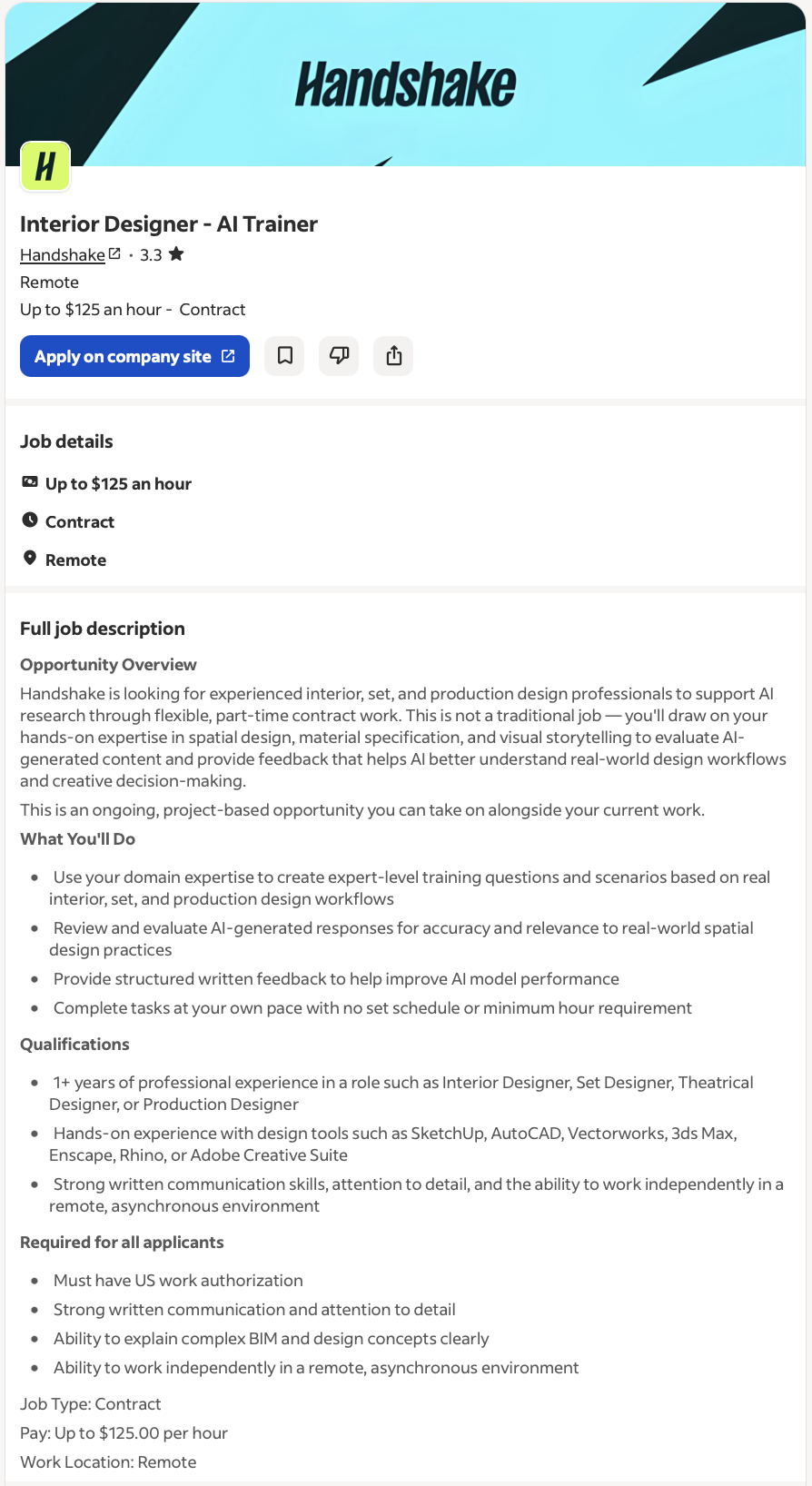
Image via Handshake
Our experience has lasting value
Interior design is a profession built on much more than selecting furniture or producing a beautiful image. We listen to clients, learn how they live, plan spaces, select materials, solve problems, manage budgets, and coordinate the details that turn an idea into a finished project.
We also learn through experience. We know when a material that looks beautiful may not be practical for a family with young children. We know how a room feels when we walk into it and how light changes throughout the day. We learn to ask questions that help clients identify what they need, even when they are not sure how to express it.
That knowledge has value. An hourly payment may compensate a designer for their time, but the company may continue to benefit from what that designer taught its AI system long after the work is finished.
The job posting I saw did not explain how the designers’ contributions would be used in the future. It is possible that the work could help develop tools that support designers. It is also possible that the technology could be used to perform services that clients would otherwise hire designers to provide. We deserve to know more before we share our expertise.

Image via Pexels
An image is only one part of a project
AI can already generate images of rooms and suggest furniture and finishes. Some of those images are appealing, and I can understand why a client might find them exciting.
But a design concept is only the beginning. Someone still needs to understand the actual space, verify dimensions, select suitable products, establish a realistic budget, and make sure the pieces work together. Someone needs to communicate with the client, respond to concerns, and make decisions when unexpected issues arise.
A designer does all of this while paying attention to the people who will live or work in the space. That relationship matters. It is how we create interiors that feel personal and function well in everyday life.
I worry that as AI-generated images become more common, people may come to see design as something that can be produced instantly. They may not see the work behind a finished room or understand why professional guidance is valuable. That could place pressure on designers to lower their fees and make it harder for new designers to find opportunities.

Image via Pexels
We should pay attention to what is happening in other fields
The effect of AI on jobs is still developing. We cannot say with certainty what will happen to interior design or how many positions might be affected.
What we do know is that researchers are watching changes in occupations where AI can perform or assist with certain tasks. Stanford’s Digital Economy Lab has found employment changes among younger workers in some occupations highly exposed to AI, although it has not found evidence of widespread displacement across the economy. The International Labour Organization also points out that exposure to AI does not necessarily mean a job will disappear. Some jobs may change as certain tasks become automated. digitaleconomy.stanford.edu
For designers, this is a good time to ask questions and make informed choices about how our expertise is used.

Image via AI
Before accepting an AI training job
I understand why these positions are attractive. A flexible schedule and a high hourly rate can make a meaningful difference, especially for independent designers. Each person’s circumstances are different, and I respect that.
At the same time, I encourage my colleagues to look carefully at the opportunity and ask:
How will my work and professional knowledge be used?
Who will own the questions, examples, and feedback I provide?
Which companies will have access to the information?
Is the technology intended to support designers or offer an alternative to hiring them?
Could my contribution affect future opportunities for people in my profession?
If the answers are not clear, ask for them. The rate of pay is one part of the decision. The future use of our knowledge is another.
For me, I would not feel comfortable training a system that could eventually be used to compete with the services I provide. I would encourage other designers to consider that possibility before accepting this type of work.

image via AI
The future of design should include designers
Technology will continue to change our industry, and designers should have a voice in how it is developed and used. We can ask companies to be transparent and to respect the professionals whose knowledge helps make their products possible.
We can also continue to show clients what we bring to a project: our experience, our attention, our creativity, and our commitment to making spaces work for the people who use them.
Interior design is personal. It begins with understanding someone’s life and continues through countless decisions made with care. That work deserves to be recognized, valued, and protected.

Image via University of South Carolina